

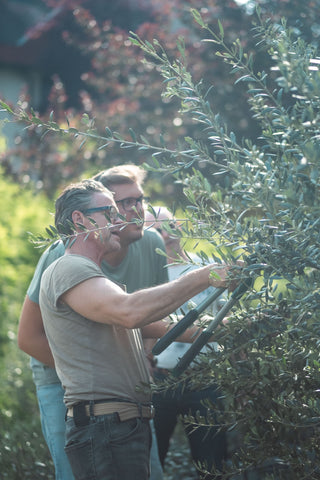
When it comes to olive trees, completely different pruning principles apply compared to native fruit trees such as apples, pears, or cherries. While with these traditional fruit trees, care is usually taken not to remove branches larger than 4 cm in diameter – perhaps due to the risk of wound diseases or the lack of dormant buds – the situation is completely different with olive trees.
The olive tree is an extremely regenerative plant, capable of sprouting new shoots even from seemingly dead old wood, such as the trunk or thick, old branches. It doesn't have the classic dormant buds beneath the bark like our native trees, but rather so-called 'epicormic buds,' some of which are buried deep within the wood and can still be reactivated even after a long period of inactivity.
In traditional Mediterranean olive cultivation, it is absolutely common practice—especially when rejuvenating old trees—to carry out very severe pruning, removing branches with a diameter of 10, 20, or more centimeters. Such radical measures are necessary to bring light into the crown, promote vitality, and make room for new, fruitful shoots.
As long as pruning is done properly—that is, not during frost, with clean tools, and ideally in dry weather—the tree will not suffer lasting damage. The olive tree is evolutionarily perfectly adapted to such interventions. In many regions, olive trees are completely cut back after decades of neglect and still sprout new shoots.
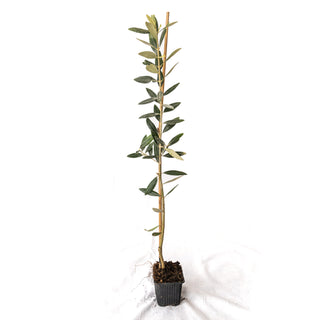
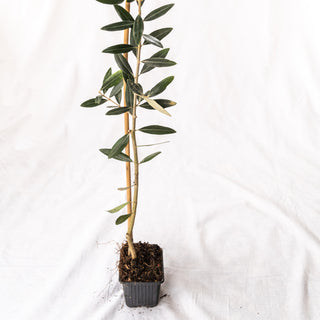
![Olea Europaea "Empeltre" – the Catalan newcomer [PRE-ORDER SPRING 2026]](http://pannolio.at/cdn/shop/files/Aglandau-1_63025968-508b-4ba5-923d-3df06a6eea6b.jpg?v=1709023033&width=320)